Meme source guide
Tiny Desk AI Trend: The Meme’s Origins & Variations
The Tiny Desk AI trend puts a new cast into short, joyful desk-concert scenes associated with Charlie Wilson’s real NPR performance of “Outstanding.” Here is what came from the concert, what later creators changed, and where the evidence stops.
This English research and replication guide was checked against the cited public sources and MakeHit’s current Tiny Desk configuration. It does not report a new generation test.
Tiny Desk AI in 30 seconds
The shortest useful answer separates the musical source, the later AI recast and MakeHit’s preset implementation.
- Real performance
- Charlie Wilson’s NPR Tiny Desk Concert, dated June 5, 2023 by his official announcement.
- Song
- “Outstanding” by The Gap Band. The people in an AI recast did not newly record it.
- Documented AI example
- A 19-second college-football consolation recast profiled by The Athletic on October 23, 2026.
- MakeHit version
- New-cast 9:16 MP4s with prepared audio: 8, 10 or 15 seconds—not the 19-second sports edit.
The real concert & the AI meme are not the same thing
NPR’s Tiny Desk Concerts are real performances filmed around an office desk. The AI trend is a later remix format: creators recast the recognizable singer and band, preserve or evoke the musical performance, and turn the close-ups and reactions into a joke about a team, a friend group or another familiar cast.
The recurring musical reference is Charlie Wilson’s performance of The Gap Band’s “Outstanding,” not a newly recorded performance by the people shown in an edit. Some tools manipulate existing footage. Others, including MakeHit, generate a new cast scene from a prepared motion and audio route. Calling every version a simple filter hides that difference.
If your goal is to operate the tool rather than research the meme, go straight to the Tiny Desk AI video replication guide. It covers the real inputs, three plays, credit costs and fixes without repeating this history.
Start with Charlie Wilson’s June 2023 performance
The verifiable starting point is a real event. Charlie Wilson’s official concert announcement dates his NPR Tiny Desk Concert to June 5, 2023 and presents it as a Black Music Month performance. It also identifies “Outstanding” as part of the finale. Wilson was the lead singer of The Gap Band, whose song supplies the familiar musical payoff.
The setting is part of the appeal. A lead vocalist works close to a desk microphone and headphones, the keyboard and backing performers sit unusually close, and the camera moves between an exuberant singer and instrumental responses. The Athletic’s October 2026 report describes NPR Music’s longer-running Tiny Desk series as live videos recorded behind an office desk at NPR headquarters in Washington, D.C.
A smile or laugh near the end lands differently from a polished stage spectacle: the performer seems to be enjoying the room rather than performing at a distant crowd. That close-range energy is what remains recognizable after the cast changes.
How the October 2026 sports recast made the format travel
A documented sports example helps explain the meme without inventing a “first ever” post. On October 23, 2026, The Athletic profiled a 19-second AI-created video that placed five college football coaches into Wilson’s June 2023 performance after their teams lost on the same Saturday. The creator, identified as Jake, said he used Higgsfield and motion-transfer models and spent a couple of hours shaping the result.
The joke works through contrast. “Outstanding” is celebratory, while the chosen coaches represented a weekend of losses. Recasting them as a committed, happy band creates a consolation concert rather than another angry reaction. The expressive lead, supporting roles and sax response also give a creator several identities to assign, which makes one musical clip useful for a whole group.
The same report preserves reactions and audience claims circulating at that time, but this article does not carry those figures forward as current measurements. Nor does one documented successful post prove that it was the first AI Tiny Desk edit, the only format in circulation, or the ancestor of every later version.
See the reported 19-second structure at a glance
The recast is more than a desk background: its lead, ensemble, laugh, sax response and final reaction arrive as separate comic beats. This attributed map helps you recognize the structure without confusing it with MakeHit’s outputs.
- 010–1.4s
Side profile
The lead starts in profile with their head down.
- 021.4–6.7s
The band
Backing singers deliver the opening line; the keyboard stays in the scene.
- 036.7–13s
Lead close-up
The singer looks up, performs, laughs and waves it off.
- 0413–16.4s
Sax solo
The sax takes over while the keyboard player remains visible.
- 0516.4–19s
Ensemble finish
The view returns to the group for the final celebratory gesture.
Sports, families & fictional performances: what changes in a variation
Each variation changes the casting premise while relying on recognizable musical and visual cues. These are documented patterns, not audience rankings.
| Variation | What the cast communicates | Verified example and limitation |
|---|---|---|
| Sports consolation | Coaches or fans share an exuberant performance after a disappointing result. The audience needs the sporting context to get the joke. | The Athletic, Oct. 23, 2026. Supports one sports case, not a first-post claim. |
| Family recast | A recognizable family occupies the performers’ roles, producing an imagined concert that viewers can easily distinguish from a booking announcement. | Complex, Nov. 4, 2026. Reported a Braxton-family edit shared on Nov. 3. |
| Friends and custom casts | People assign the lead and supporting roles to friends, colleagues, celebrities or fictional characters. Caption and role choice carry the premise. | Kapwing’s public template. Supports the range of requested casts, not their popularity. |
The Braxton example makes the original/AI distinction especially important. Complex reported that Toni Braxton shared an edit placing family members into Charlie Wilson’s backing ensemble and that fans responded by asking for a real Tiny Desk. The AI clip imagined a family performance; the report did not establish that such an NPR concert had happened.
Across these versions, three things can change independently: the people, the editing or generation method, and the exact duration. A 19-second sports edit, an approximately 19-second third-party template and MakeHit’s 8-, 10- or 15-second plays should not be collapsed into one supposedly universal output.
Why the close-ups, band roles & music carry the joke
- The lead is the premise. Put a coach, friend or family member at the center and their familiar identity reframes the whole performance.
- The band confirms the commitment. Backup performers and instrumentalists make the recast feel like an ensemble event rather than one face pasted onto a random clip.
- The reaction makes it human. Headphones, smiles and a laugh break the seriousness of the impersonation. Bad hand, instrument or mouth movement can just as easily break the illusion.
- The caption sets the context. The same cast can celebrate a birthday, console a fan base or introduce a group-chat joke; the music alone does not decide which reading applies.
This is why simply preserving a desk and bookshelf is not enough. A convincing recast still needs distinct identities, intentional role assignments and watchable contact with microphones and instruments. Those are review criteria, not a promise that any generator will get every frame right.
Where MakeHit fits & what it does not claim to recreate
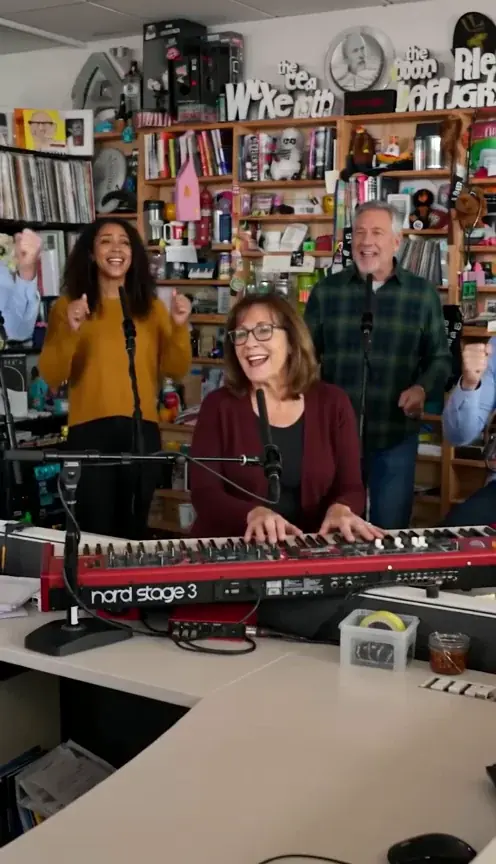
MakeHit implementation example
A new cast scene, not the original concert
This retained source-project image is the poster for cutB, the 15-second Full Desk Jam example in One-per-member mode. It illustrates MakeHit’s preset approach; it is not NPR footage, the 19-second sports edit or a new MakeHit end-to-end test.
Use the Tiny Desk AI Create area for the live controls and current credit total. For exact group-photo positions and matching cutA/B/C examples, use the step-by-step replication guide.
Label the edit honestly & check what a source cannot prove
Permission to upload a person’s photo does not automatically settle rights in a song, a recorded performance, logos or third-party artwork. Conversely, describing a result as “AI-generated” does not replace those permission checks. Review all visible people and the prepared audio before posting, and check the destination platform’s current synthetic-media and music rules. This is a practical checklist, not a legal clearance or commercial-use guarantee.
A caption such as “AI-generated fan edit” is clearer than presenting a fictional performance as a real NPR booking. If friends, private individuals or public figures appear, use likenesses you are authorized to animate and avoid implying an endorsement that never happened.
Unverified items kept out of the origin story
- No source checked here establishes the first AI Tiny Desk edit or one universally accepted originator.
- Historical view and impression figures are not rechecked live audience totals.
- Not every variation uses the same 19 seconds, identical source footage, model or face-swap method.
- A reported fan request for an NPR booking is not evidence that the booking occurred.
- MakeHit’s older example provenance does not include recovered provider task IDs or historical model settings, so none are claimed.
Continue from the source story to the actual tool
Each page has one job: origin and meaning here, live generation controls on the detail page, and detailed replication decisions in the guide.